

The 10 Worst SEO Mistakes to Avoid (That Impact Your GEO too)

Image2

The 10 Worst SEO Mistakes to Avoid (That Impact Your GEO too)

SEO has changed. Or rather, its playing field has changed.

Google no longer simply ranks pages. LLMs synthesize, rephrase, and select. Visibility no longer depends solely on ranking, but on your ability to be understood, structured, and cited.

And yet, the fundamental mistakes remain the same.

They are not always major technical disasters. More often, they are oversights. Blind spots. Details we think are secondary, until visibility drops.

A poorly configured robots.txt.
Non existent internal linking.
Content that talks, but does not answer.

In an ecosystem where Google ranks and ChatGPT responds, these mistakes are no longer just penalizing. They become invisibilizing.

Here are the 10 mistakes that still too often sabotage SEO performance, and that in the age of LLMs cost twice as much.

1. Neglecting structured data

Today, if you do not clearly tell search engines who you are and what you do, they have to guess. And guessing is rarely good for visibility. Without structured data, Schema.org, FAQ, Article, Organization, Author, you let Google and LLMs interpret your content their own way.

It is like writing a book without a table of contents. Humans can manage. Machines struggle.

Generative models look for clear signals, identifiable entities, defined authors, categorized products. If nothing is explicit, your content becomes blurry. And in a machine driven ecosystem, blur is expensive.

Make it explicit. Clean markup, visible authors, structured entities. Make your expertise readable for algorithms.

2. Underestimating internal linking and topical consistency

Publishing articles without connecting them is like a library where the books are good but shelved completely at random. Even the librarian eventually gives up.

Internal linking tells a story: here is our main topic, here are the subtopics, here are our pillar pages. Without that, your authority remains fragmented.

And for LLMs, this is even more critical. Models evaluate the overall consistency of a domain. If your content is isolated, it sends a weak expertise signal. Structure your clusters, clarify your pillar pages, use descriptive anchor text. Make it clear that you truly master a topic — in depth.

3. Not optimizing for explicit questions

Queries are becoming increasingly conversational. Users no longer just type “SEO audit,” they ask: “How do you perform an SEO audit?”, “Why is my website not ranking anymore?”, “What is the difference between SEO and GEO?”. If your content does not clearly answer these formulations, you miss featured snippet opportunities… but more importantly, LLM visibility.

Generative models work through extraction and synthesis. They look for clear, structured, explicit answer blocks. If your content remains vague, overly narrative, or without direct answers, bots get “lost” in the text. They struggle to identify usable answers and will favor clearer sources. And as a result, you disappear from AI-generated responses.

The solution is not to stack artificial FAQs, but to integrate natural questions into your headings, followed by concise, structured, and educational answers. Don’t hesitate to leverage your internal data to enrich your responses. In an environment where engines rank and AI synthesizes, clarity becomes a competitive advantage.

4. Poor robots.txt management

A poorly configured robots.txt can literally make part of your website invisible. It’s like locking your own store… and complaining that there are no customers. And the worst part? Many companies realize it far too late.

Accidentally blocking strategic sections or essential resources slows down crawling. And if Google cannot properly crawl your website, it cannot understand it. If the foundation is poorly crawled, the AI layer will be too.

Regular audits, checking blocked areas, reviewing after each deployment: technical SEO is prevention.

5. No clean and up to date sitemap

It is basic. But basics make the difference.

A sitemap is not a minor technical detail. It is a map. If that map contains dead URLs, noindexed pages, or outdated content, you send a signal of disorganization.

Search engines favor clean and coherent websites. An updated sitemap helps prioritize strategic pages and accelerates indexing.

6. Poorly configured multilingual architecture

International expansion is powerful. But when poorly managed, it becomes destructive.

It’s like sending a French customer to a brochure written in Dutch. They don’t understand. Google doesn’t either.

Incorrect hreflang tags, versions cannibalizing each other, users sent to the wrong language: Google hates confusion — and so do your users.

And you know what? LLMs do too. If multiple versions of the same content compete without a clear hierarchy, your site’s authority gets diluted.

A clean international architecture relies on perfect URL mapping, consistent hreflang implementation, and a market-by-market strategy. No improvisation.

7. Poor canonical tag management

The canonical tag is a strong signal. It tells search engines which version is the main one. If misconfigured, you may point to the wrong page or neutralize your own content.

In an ecosystem where models look for the most reliable and stable version of information, technical inconsistencies send the wrong signal.

One main version. No ambiguity. No contradiction.

8. Massive internal cannibalization

Multiple pages targeting the same intent are like several salespeople talking at once. The result is confusion. Rankings fluctuate. Authority gets divided.

LLMs look for the most complete and coherent page. If your website sends contradictory signals, you lose clarity.

Merge. Redirect. Reposition. Less duplication, more strategy.

9. Ignoring user experience and behavioral signals

UX is not a “nice to have.” It’s a foundation. It’s like opening a restaurant with a great menu… but uncomfortable chairs and slow service. The quality is there. The experience drives people away.

A slow website, aggressive pop-ups, poor mobile readability… it’s immediately noticeable. And even if Google does not disclose every behavioral signal, the correlation is clear: poor experience = poor performance. That’s why relying on data analysis is essential to understand what is really happening (scroll depth, engagement, journeys, drop-offs).

Less engagement, fewer backlinks, less trust. And therefore fewer chances to be perceived as a reliable source by search engines and AI.

10. Producing content without clear search intent

Creating content without analyzing search intent is like shooting blindly. You can write 3,000 perfectly optimized words and still miss the target.

Optimizing a keyword is no longer enough. You must understand what users truly want. Information. Comparison. Purchase. Diagnosis.

The four search intents: information, comparison, purchase, diagnosis

If your page does not match the dominant SERP intent, it will not perform. Not on Google. Not in LLMs.

Modern SEO is no longer about ranking for a keyword. It is about answering an intent.

Conclusion, SEO + LLM: the new equation

SEO is no longer just a battle for rankings.

It is a battle for clarity.

Search engines try to understand.

LLMs try to extract.

Users look for immediate answers.

If your website is blurry, poorly structured, contradictory, or technically fragile, it will be neither prioritized… nor synthesized.

The new rule is simple:

✔ Be indexable
✔ Be understandable
✔ Be coherent
✔ Be explicit

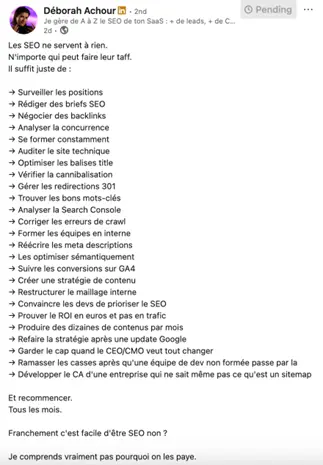
Sounds simple, right? Easier said than done. It reminds me of Déborah Achour’s LinkedIn post:

SEO, AI, and visibility in 2026

In 2026, SEO is no longer about pleasing Google. It is about becoming an exploitable source.

Those who structure their expertise, clarify their intent, and strengthen their technical foundation do not just gain rankings. They gain presence.

In a world where AI filters information before users even click, the real question is no longer “Am I ranking?” It is “Is my website a trusted source in the eyes of machines?”

Take action

Would you like to assess your readiness for Google’s AI Mode? Our experts can audit your campaigns, audience signals, and content to identify your visibility and eligibility levers.

Contact us