GML 2026 is already changing things. Are your campaigns ready?
AI Max, Display migration, Performance Max, Attributed Branded Searches: several deadlines are already active in Belgium. Universem helps you stay ahead.
Google Marketing Live 2026, held in late May, doesn’t just announce the future. Several changes are already underway, with precise deadlines: AI Max, the forced migration of Display campaigns, a new metric to measure the impact of video campaigns on brand search. These are decisions to make now, not trends to watch.
At Universem, we follow these developments closely for our clients. AI doesn’t replace our expertise: it allows us to go faster and further, with more precision. Here is what GML 2026 means concretely for your campaigns.
AI Max: the end of keyword-based management
AI Max for Search adds an expansion layer to your Search campaigns: your keywords remain a starting signal, but AI also captures long and conversational queries you would never have targeted. According to Google, this generates on average +14 % in conversions at equivalent CPA, and up to +27 % for campaigns historically based on exact and phrase match.
And this is not optional: Dynamic Search Ads will be automatically migrated to AI Max in September 2026.
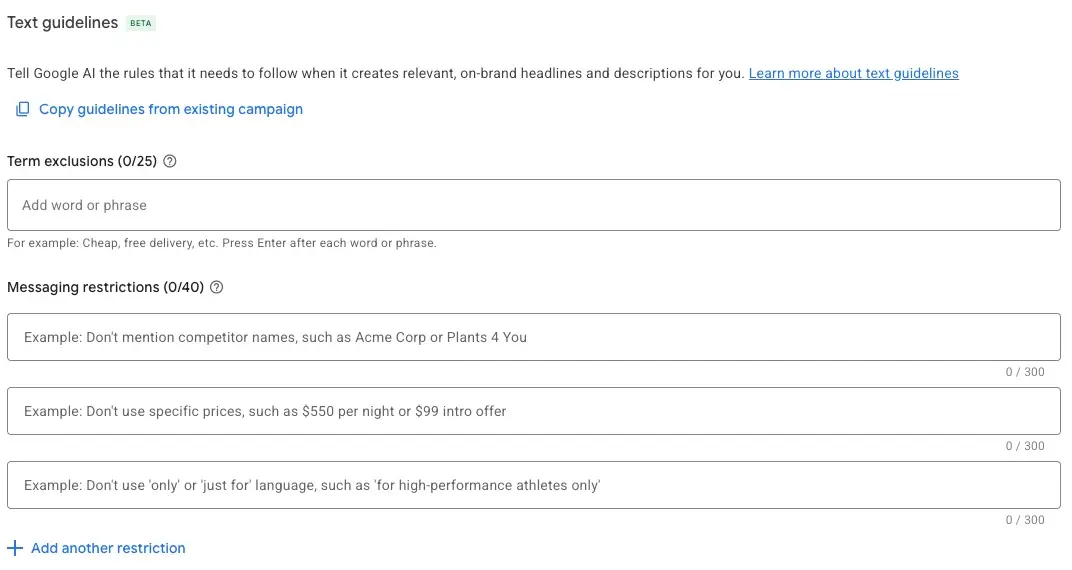
Keeping control: exclusions and restrictions
Brand exclusions
A list of competitor brands to exclude before activating keywordless expansion, to avoid appearing on their queries.
Term exclusions (25 max per campaign)
Words that should never appear in generated ads, specific to each language.
Message restrictions (40 max)
Natural language instructions on tone and editorial limits, applied semantically in all languages.
Landing page matching
With AI Max, Google can send your visitors to any page of your site deemed relevant, not necessarily the one indicated in the ad (Final URL expansion). You can disable this feature at campaign level if you need precise control, or expand the list of included URLs at ad group level to let AI choose the most relevant one.
At Universem, we are already activating AI Max for our clients on selected campaigns rather than waiting for the automatic DSA migration planned for September 2026. This allows us to progressively understand algorithm behaviour, identify relevant expansion opportunities and put the necessary safeguards in place before a wider rollout.
We advise against activating AI Max without having first defined brand exclusions, term exclusions and message restrictions. Without this framing, AI may expand delivery beyond the desired scope or generate messages that do not faithfully reflect your brand positioning.
💡 Key takeaways
- Test AI Max on a limited scope now, rather than waiting for the automatic migration in September 2026.
- Set up brand exclusions, term exclusions and message restrictions from launch.
- Check the landing page report weekly during the first month.
- Exclude out-of-scope URLs at campaign level, expand by ad group where relevant.
Ads enter AI-generated answers
AI Mode has surpassed one billion monthly users, with queries three times longer than in classic Search. Google is now integrating advertising formats directly into generated answers.
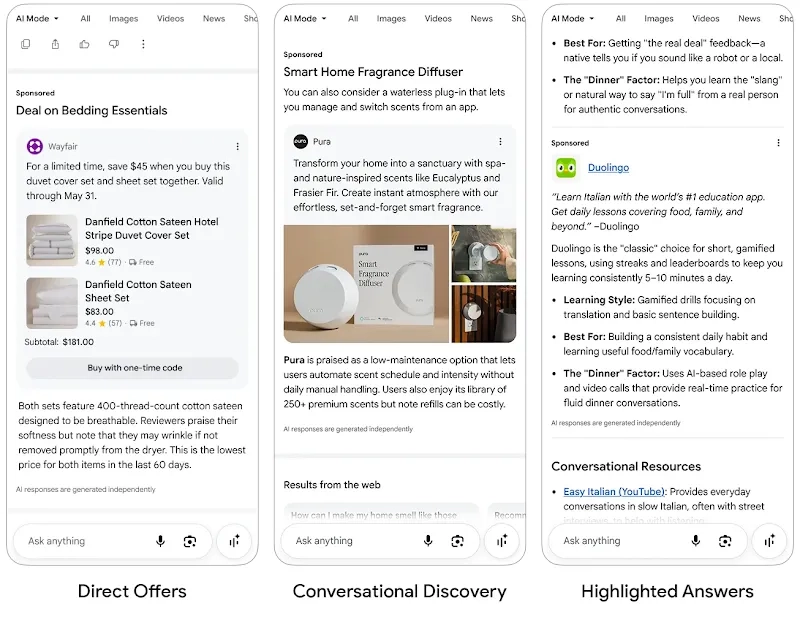
Direct Offers
Exclusive offer automatically applied via Google Pay at the moment of purchase intent.
Business Agent for Leads
The prospect asks a question from the ad, the answer comes from your site’s content. Tested in education, automotive and real estate.
Shopping Ads Gemini
Descriptions generated from your product feed. Accessible only via AI Max or PMax with text customization.
💡 Key takeaways
- Priority deployment in the United States. Belgium expected within 6 to 12 months.
- The quality of your site and feeds directly determines the relevance of generated answers.
- A fast, well-structured site becomes a direct advertising lever.
Display is ending. Demand Gen takes over.
Standalone Display campaigns are gradually disappearing. From June 2026, a migration tool is available in Google Ads. It will then no longer be possible to create new Display campaigns, and remaining campaigns will be automatically migrated before end of 2027.
Demand Gen takes over the Display scope and extends it to YouTube, Discover, Gmail and Maps. According to Google, adding the Display network to Demand Gen generates on average +9.5% ROI.
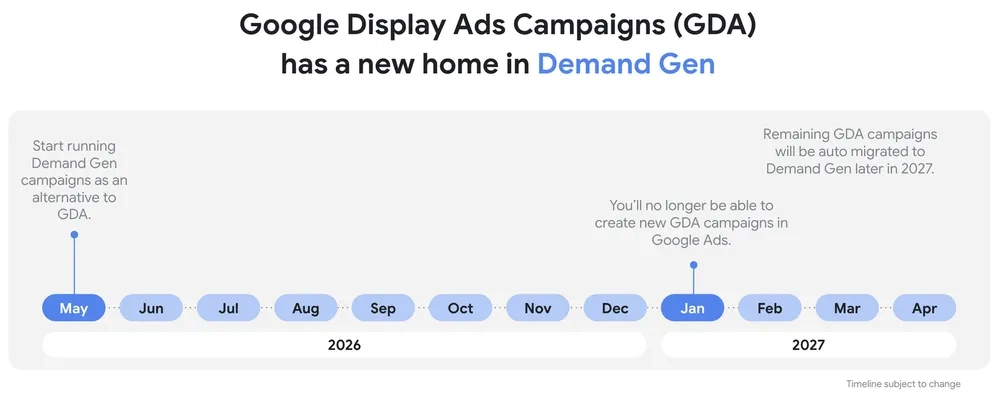
June 2026
Migration tool available
After June 2026
Creating new Display campaigns no longer possible
End of 2027
Automatic migration of all remaining campaigns
💡 Key takeaways
- Voluntary migration available from June 2026, automatic before end of 2027.
- A forced migration will not preserve the fine-tuned settings built up over the years.
- Audit placements, audiences and negatives before migration.
Performance Max: network-level visibility finally available
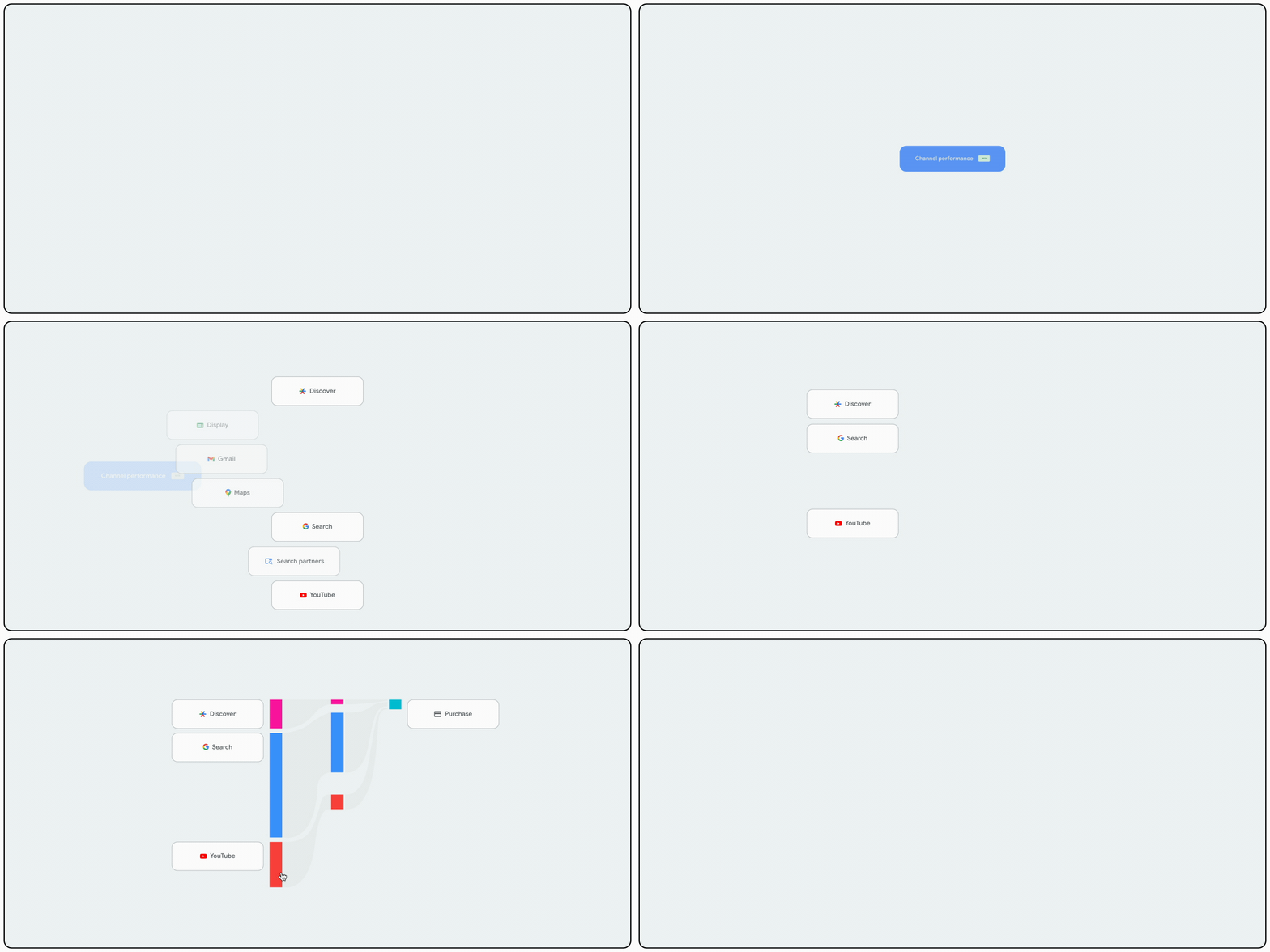
The channel view and access to Search queries generated in PMax already existed in beta for about a year. The real novelty of GML 2026 is segmentation of placement reports by network : you can now precisely identify where your ads appeared, a key point for brand safety. This view is accessible directly from the « When and where ads showed ».
PMax is no longer a black box, but a box with a window. You can now see which networks your ads appear on, enabling you to detect brand safety issues. However: PMax does not offer a native lever to exclude a specific placement or manually reallocate budget between channels. This visibility remains an alert signal, not a direct action tool.
💡 Key takeaways
- Network segmentation in placement reports is the key novelty to note for 2026.
- Available directly in the “When and where ads showed” tab.
- Visibility tool, not direct action: precise placement exclusions remain limited in PMax.
Attributed Branded Searches: measuring the impact of video on brand
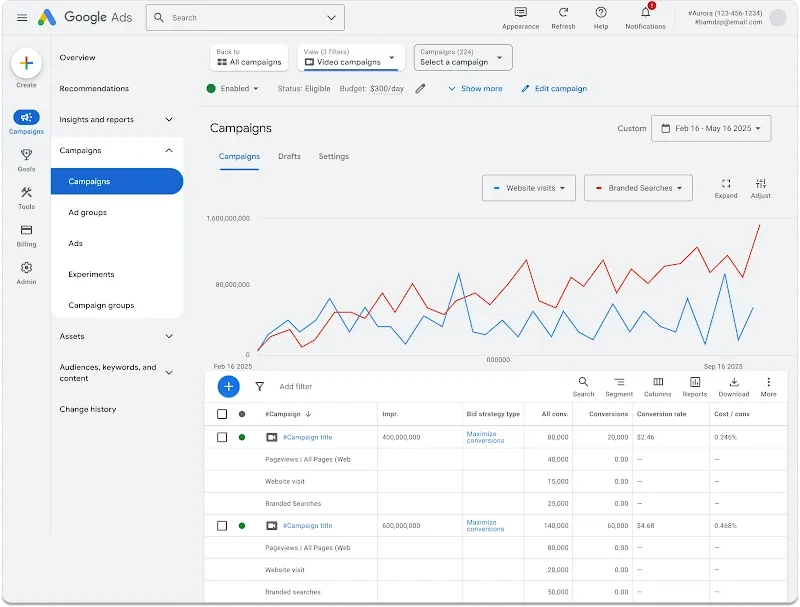
New always-on metric, Attributed Branded Searches (ABS) connect exposure to a YouTube campaign to a subsequent brand search. Unlike total brand search volume, ABS only counts users who actually saw the video ad: it is a directly attributable subset.
The main benefit: a leading performance indicator for brand awareness campaigns, available continuously, that complements incrementality experiments without waiting for their results. It finally becomes possible to connect a brand campaign to concrete search behaviour, from discovery to decision.
By GML or within the following six months: AI Mode support, availability in Display & Video 360, new searcher segmentation, and a self-service tool for brand mapping.
💡 Key takeaways
- ABS only counts brand searches from users exposed to a YouTube ad.
- Complementary to incrementality tests, with results available continuously.
- Ask your Google representative for the cost per ABS and sector benchmarks to position your performance.
Belgium: when does all this apply to us?
✓ Already active in Belgium
- AI Max (text guidelines since February 2026)
- Display to Demand Gen migration
- Network segmentation in PMax
⏳ Expected within 6 to 12 months
- AI Mode conversational formats
- Full extension of Attributed Branded Searches
What this changes for your Ads strategy
AI is taking over more and more operational tasks: intent-based management, text generation, placement selection. But it doesn’t decide your strategy, doesn’t know your legal constraints or your seasonality.
The agency’s role evolves but does not disappear. As AI increasingly automates execution, value shifts towards strategy, analysis and decision-making. Defining priorities, interpreting signals, understanding business challenges, questioning platform recommendations and turning data into concrete action plans remain deeply human missions.
Beyond the features announced at GML 2026, it is the entire Search landscape that is evolving. Users are formulating longer, more conversational queries and now expect contextualised answers rather than a simple list of links. This evolution is gradually bringing SEO, SEA and AI-based conversational experiences closer together. Brands that correctly structure their content, data and advertising signals will be best positioned to gain visibility in this new environment.
AI allows us to do more, faster, with more precision.
It works better when it is properly framed. That is exactly what Universem does for you.