ChatGPT Ads, 2 months in: what’s changing, what works and what’s coming in 2027
 Jérémie Marti·OCTOBER 29, 2026·8 MIN
At the end of August, advertising arrived in ChatGPT in Belgium. We asked a simple question back then: new gold rush or just a copy of Google? 2 months later, we have our first answers.
A quick reminder of the context: ChatGPT is no longer a niche tool. It is the brand Belgians value most according to Kantar BrandZ 2026, and 37% of Belgians aged 16 and over use it every month, around 3.4 million people (Space, August 2026). When a brand takes up that much room in everyday life, advertising on it quickly becomes a topic for advertisers.
Here is what we have learned, from testing at Universem but also from talking with partner agencies in the Dall International network in the United Kingdom, Poland and Denmark.
How an ad appears in ChatGPT
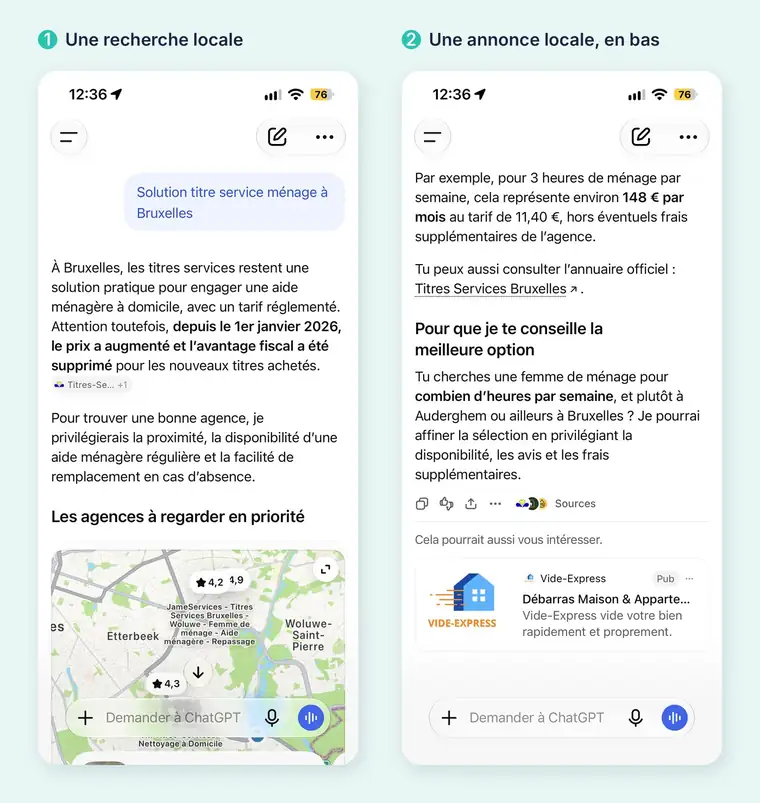
In practice, the user asks a question, ChatGPT answers, then the ad appears below the answer, labelled “Sponsored”. It does not change ChatGPT’s answer: it comes after it.
Let’s be honest: for now, the format is not very subtle. The ad sits at the bottom of the chat, outside the flow of the conversation. We are far from a recommendation woven naturally into the exchange. It is a deliberate choice by OpenAI to preserve user trust, but it is also what still limits the format’s impact.
And locally, it already works. We ran the test in Brussels with a simple question: “Service voucher cleaning solution in Brussels”. ChatGPT answers with a map of agencies in the area, then shows an ad from a Brussels company at the bottom of the chat. Geographic targeting works. Relevance, however, still needs work: the ad is for a house clearance service, not cleaning. Proof that an advertiser’s context hints matter as much as their location.
What has changed since August
In 2 months, OpenAI has added a lot. The main changes:
- ▪Self-service: since September 1, a European advertiser can create campaigns on their own, without going through OpenAI’s teams.
- ▪A creative assistant: the platform suggests headlines, descriptions and visuals based on your website. You stay in control and can edit them.
- ▪Managing campaigns inside ChatGPT: a plugin lets you create and analyse a campaign simply by writing what you want.
- ▪Product catalogues: e-commerce brands can show their products in a carousel below the answer.
- ▪HubSpot and Shopify: linking an ad to a sale or a closed deal is getting easier.
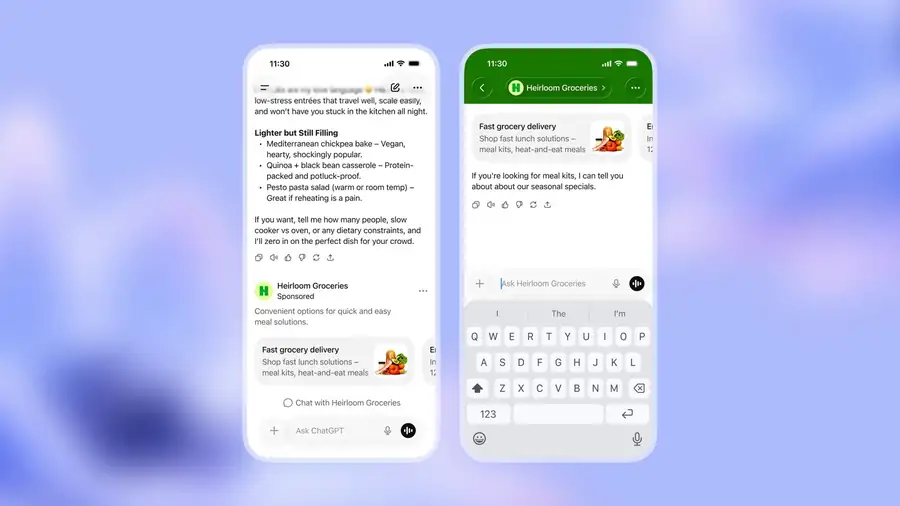
- ▪Chatting with the brand: in the United States, an ad can open a conversation with the brand’s AI assistant. The ad no longer just sends people to a website, it opens a dialogue.
What’s coming: a visual format and measurement beyond the click
On October 5, OpenAI announced 2 major developments.
1. A visual format. An image ad will appear while ChatGPT generates an image for the user: a product in context, an inspiration, an experience. The test starts in October in the United States. For fashion, home decor, travel or food, it is a real shift: ChatGPT Ads also becomes an inspiration lever, closer to Meta or Pinterest than to Google.
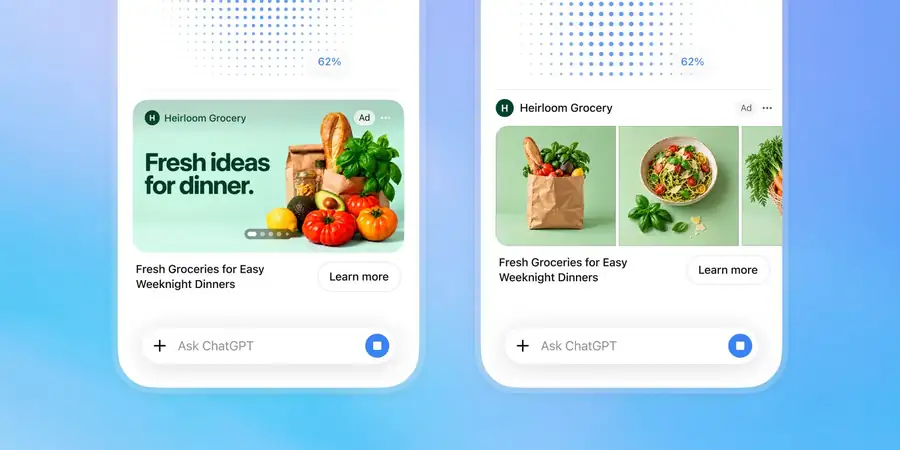
2. Measurement that no longer stops at the click. This was our main reservation in August. Now, if someone sees your ad without clicking, then buys within 24 hours, that conversion is counted. It is the logic Meta has applied for years. OpenAI is also adding a score that rates the quality of your tracking, and more than 20 measurement partners (AppsFlyer, Northbeam, Haus, Kantar…).
The first published results are encouraging: WeightWatchers reports a cost per acquisition 15% lower than its Search campaigns. But let’s stay cautious: these figures are selected by OpenAI and its partners, with no detail on budgets or duration.
6 best practices to get started
1. Think situations, not keywords. On ChatGPT, you don’t buy keywords. You describe, with “context hints”, the situations where your offer is useful. OpenAI’s method boils down to 3 questions: what (your offer), who (the customer’s need), when (the moment they need it). What works best: concrete, urgent needs. A broad theme like “maintenance tips” draws volume, but few buyers.
2. One ad group = one need. Each group has its own situation, its own message and its own landing page. It is also the only way to understand what works, since ChatGPT does not show the questions that triggered your ads.
3. Write the way people talk. The user has just read a detailed answer. An overly commercial message stands out. An advisory tone works better. And keep it short: OpenAI recommends around 16 characters for the headline and 32 for the description, because everything else gets cut off on mobile.
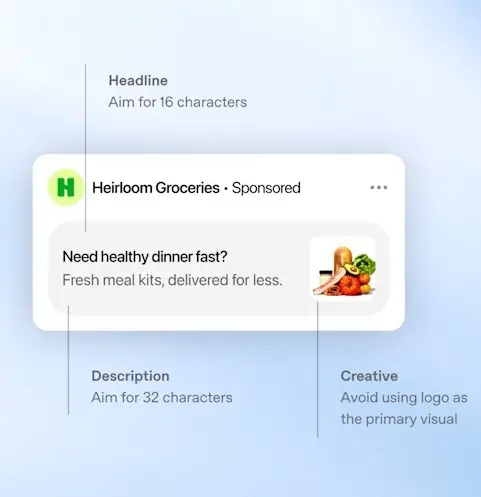
4. Set your own bids. At launch, suggested bids are often high, then stabilise. It is better to start from an amount consistent with your margins and your Google CPCs.
5. Check tracking from week one. Pixel, Conversions API and UTMs are essential. Also compare the platform’s clicks with your sessions in Google Analytics: significant gaps have been observed.
6. Set a decision date. A test budget, a duration and success criteria defined before launch. Otherwise, you end up testing forever.
What we’re seeing in the field
In Belgium, a cautious start. Observed CPCs are around €1.50 to €2 in lead generation, well below the $3 to $5 initially announced. But volumes remain low, much lower than in the United Kingdom. Ads also seem to appear more often for logged-in users. An observation, not an official rule.
In the United Kingdom and Denmark, clearer signals. High-intent e-commerce works: the best results come from campaigns tightly targeted on a specific need.
Another notable point: the ad is always alone on screen. Not 4 ads side by side as on Google.
Our conclusion. Today, ChatGPT Ads is a testing ground, not a guaranteed performance channel. Strong results exist, but they depend heavily on the product and the urgency of the need. And in some cases, being well cited in ChatGPT’s organic answers (GEO) converts better than advertising.
ChatGPT Ads vs Google Ads vs Meta Ads
| ChatGPT Ads | Google Ads | Meta Ads | |
|---|---|---|---|
| Moment | Exploring, comparing | Searching | Scrolling |
| Targeting | Described situations (context hints) | Keywords, AI Max | Creative and audiences |
| Format | Below the answer, text + image | Search, Shopping, video | Image, video, Reels |
| Measurement | Click + 24h after a view | Very comprehensive | Click + 24h after a view |
| Transparency | User questions not visible | Search terms visible | Placements visible |
| Competition on screen | 1 single ad | Up to 4 ads | Crowded feed |
| Belgium | Launched, low volumes | Mature | Mature |
What they share. The same tracking tools (Pixel, Conversions API). The same trend as Google: fewer manual settings, more algorithm. Context hints look a lot like AI Max, where the keyword becomes one signal among others.
The differences. On ChatGPT, users explain their need in detail, but the advertiser sees nothing of the conversation. Targeting is based on the topic, not the profile: in Europe, ChatGPT does not use the user’s history for advertising. Meta already uses conversations with Meta AI to target its ads, but not in the European Union.
And Google? In the United States, Google already shows ads in its AI answers (AI Overviews and AI Mode). In Belgium, these ads are not available yet. It is probably the most anticipated response to ChatGPT, and we are following it very closely.
Our outlook for 2027
1. We will buy situations, no longer words. Google, ChatGPT and Meta are all heading the same way: understanding an intent rather than buying a keyword. Brands that truly know their customers’ questions will have a head start.
2. Measurement will become more holistic. A journey can start in ChatGPT, go through Google and end in store. Last click is no longer enough. Incrementality tests and brand search tracking become essential.
3. Creative will be back at the centre. Visual formats, carousels, conversations with the brand: conversational advertising will not just be about text. And a message that doesn’t sound human will stand out even more in a conversation.
4. GEO and GEA will move forward together. Ads don’t influence ChatGPT’s answers. But a brand absent from organic answers will have to pay more to exist. Advertising tests the messages, GEO builds credibility.
5. Search will be global. ChatGPT is not the new Google. It is one more touchpoint, alongside Google, YouTube, TikTok, Amazon or Maps. The real question is not “should we be on ChatGPT?”, but “where do my customers express their need, and am I there at that moment?”.
ChatGPT Ads is neither a gold rush nor a gimmick. It is a new learning ground that rewards those who test it with method, curiosity and a critical eye. That is exactly our approach at Universem.
Sources
- Building advertising for the way people use AI, OpenAI (October 2026)
- Our approach to advertising and expanding access, OpenAI
- Write context hints for ChatGPT Ads, OpenAI Help Center
- Seen from Space: évolution de ChatGPT en Belgique, Media Marketing (August 2026)
- OpenAI lanceert self-service ChatGPT Ads Manager in Europa, Dutch IT Channel (September 2026)
- OpenAI launches visual ads alongside image generation results, TechCrunch (October 2026)
- Meta will tap AI conversations to personalize ads, eMarketer