

Search is changing. So is your SEO strategy.
AI-generated answers, AI Overviews and hybrid search journeys are transforming organic visibility. If you want to know where your site is exposed, fragile or under-exploited, Universem can help you make sense of it.

For a long time, SEO has rested on a relatively stable framework: understanding search intent, cleanly structuring a site, producing useful content, maintaining technical quality and building domain authority. These fundamentals remain valid. But the visibility landscape has changed.
With the arrival of AI-generated answers, AI Overviews, conversational engines and hybrid search interfaces, organic presence is no longer played out solely in a list of links. Part of the answer can now be synthesised before the click even happens. The challenge is therefore no longer just about ranking well. It becomes broader: being visible, understandable, credible and usable by both search engines and users.
This is precisely the point that too much content over-simplifies. No, AI is not killing SEO. But it is raising the bar. It further exposes generic content, interchangeable pages and purely mechanical approaches. Conversely, it reinforces the value of useful, well-structured, reliable, differentiated content that is genuinely designed to help.
AI doesn’t replace SEO: it makes SEO more demanding
Google states this clearly in its documentation: using AI to produce content is not a problem in itself. What is a problem is publishing content without added value, produced at scale, with little originality or designed primarily to manipulate organic visibility.
In other words, the question is not whether the text was written with or without AI. The real question is: does this content genuinely help the user? Does it provide a clearer answer? More useful? More precise? More reliable? More complete? Easier to use than what already exists in the results?
This is where AI changes the game. Because it reduces production costs, it mechanically increases the volume of published content. And the higher the volume rises, the more differentiation comes down to actual quality.
Today, a page performs less through the simple repetition of a keyword than through its ability to:
- →answer a real intent precisely;
- →structure information in a readable and usable way;
- →demonstrate credible expertise;
- →integrate into a coherent brand universe;
- →provide a useful angle, method, synthesis or proof.
From SEO to GEO: a logical extension, not a replacement
The term GEO (Generative Engine Optimization) is increasingly common. It deserves clarification.
Le SEO vise classiquement to reinforce organic visibility in search results. GEO aims to increase the chances that content is picked up, cited, used as a source or synthesised in generative environments. It is not a separate discipline. It is an extension of SEO in a new display mode.
Content is more likely to be used in a generative logic when it has several qualities:
In practice, this means that SEO fundamentals remain valid, but they are being assessed in a more demanding environment. Search engines haven’t stopped needing quality pages. They have simply added a layer of synthesis and interpretation.
What really changes with AI in search
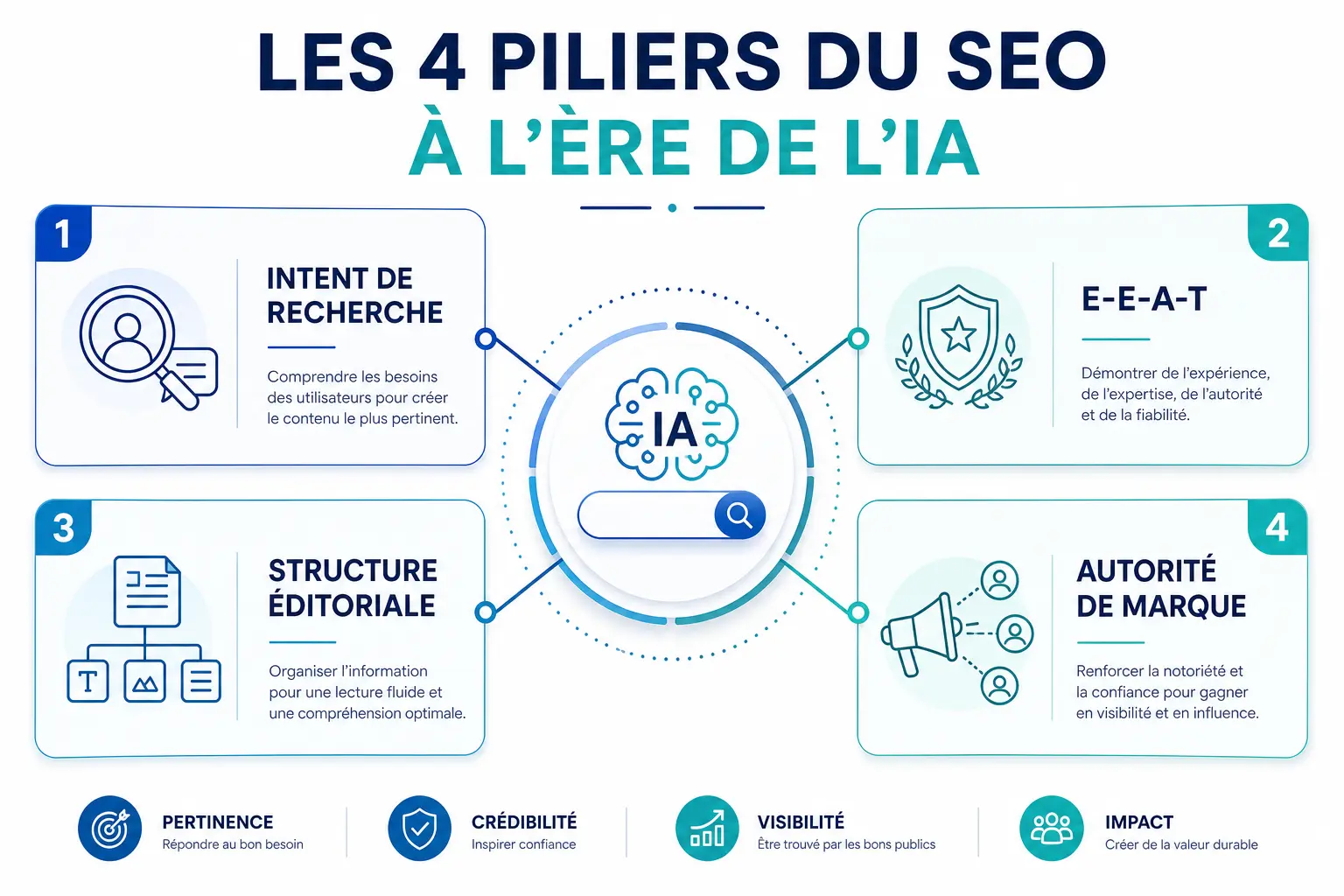
1Search intent becomes the true centre of gravity
Modern SEO is no longer about targeting an isolated phrase. It is about understanding what the user is really trying to achieve. Derrière une requête, il peut chercher une définition, une méthode, une comparaison, une validation, un prestataire, une preuve, un retour d’expérience ou une aide à la décision.
As search interfaces become more conversational, queries are also becoming more complex, nuanced and contextual. The right approach is therefore less about ‘placing a keyword’ and more about mapping the informational needs around the topic: the main question, sub-questions, objections, comparisons, expected proof and next steps in the journey.
2E-E-A-T becomes more visible in performance
L’E-E-A-T — expérience, expertise, autorité, fiabilité — is not a decorative formula. It is a very useful framework for understanding why some content inspires trust and other content does not. In a web saturated with texts that are very similar to one another, search engines need to better distinguish between superficial summaries and genuinely reliable, useful and credible content.
For a company or agency, this means that SEO work is no longer limited to the page itself. It also touches the clarity of authors, the solidity of ‘about’ pages, editorial consistency, brand reputation, external mentions and proof of expertise.
3Editorial structure matters even more
Both search engines and users prefer content they can understand quickly, summarise easily and connect to a clear intent. A good article in 2026 should be easy to scan, summarise, cite, interpret and connect to other content.
This implies: a clear H1, explicit H2s and H3s, short paragraphs, lists when they simplify reading, clear definitions, synthesis passages, FAQs when real questions exist and concrete examples rather than vague generalities. This requirement carries more weight now, because generative systems also rely on content readability.
4Brand authority goes beyond simple netlinking
SEO remains linked to authority, but authority no longer reduces to the number of links obtained. Visibility also depends on a broader set of signals: quality of mentions, consistency of communications, perceived reputation, presence in the business ecosystem, author credibility, quality of the linking between expertise content and commercial pages.
A brand visible in tomorrow’s search engines won’t just be ‘optimised’. It will be recognisable, trustworthy and consistent.
What still works — and works even better
Despite all the noise around AI, the solid fundamentals remain surprisingly stable.
What continues to work
- ✓Useful and original content
- ✓A genuine understanding of intent
- ✓A clear structure
- ✓Coherent internal linking
- ✓A sound technical foundation
- ✓An identifiable brand
- ✓Content that genuinely helps with decisions
What ages poorly
- ✗Mass production of pages that are too similar
- ✗Generic texts with no angle
- ✗Content written to ‘tick the box’
- ✗Articles that rewrite the SERP without adding anything
- ✗Artificial clusters with no business logic
- ✗Vague promises not supported by evidence
The main risks for brands
Producing more, but producing weaker content
This is the most common trap. AI reduces production costs, so the temptation to accelerate output is great. But publishing faster doesn’t automatically improve visibility. If production becomes simpler, differentiation becomes harder. Competitive advantage then comes from what others don’t have: genuine expertise, original data, a clear method, concrete cases, a strategic perspective.
Treating SEO as an isolated channel
SEO can no longer be treated as a silo separate from branding, reputation, commercial content, digital PR or user experience. Today, signals reinforce each other. A vague, poorly documented or low-credibility brand will struggle to establish itself, even with correctly optimised content.
Publishing correct but replaceable content
A text can be well written, well structured, technically sound… and still not perform. Why? Because it brings nothing that another article doesn’t already say. This is a crucial point: formal quality is no longer enough. You also need substance, genuine usefulness and a clear angle.
How to adapt your SEO Strategy right now
Produce less generic content, more expert content
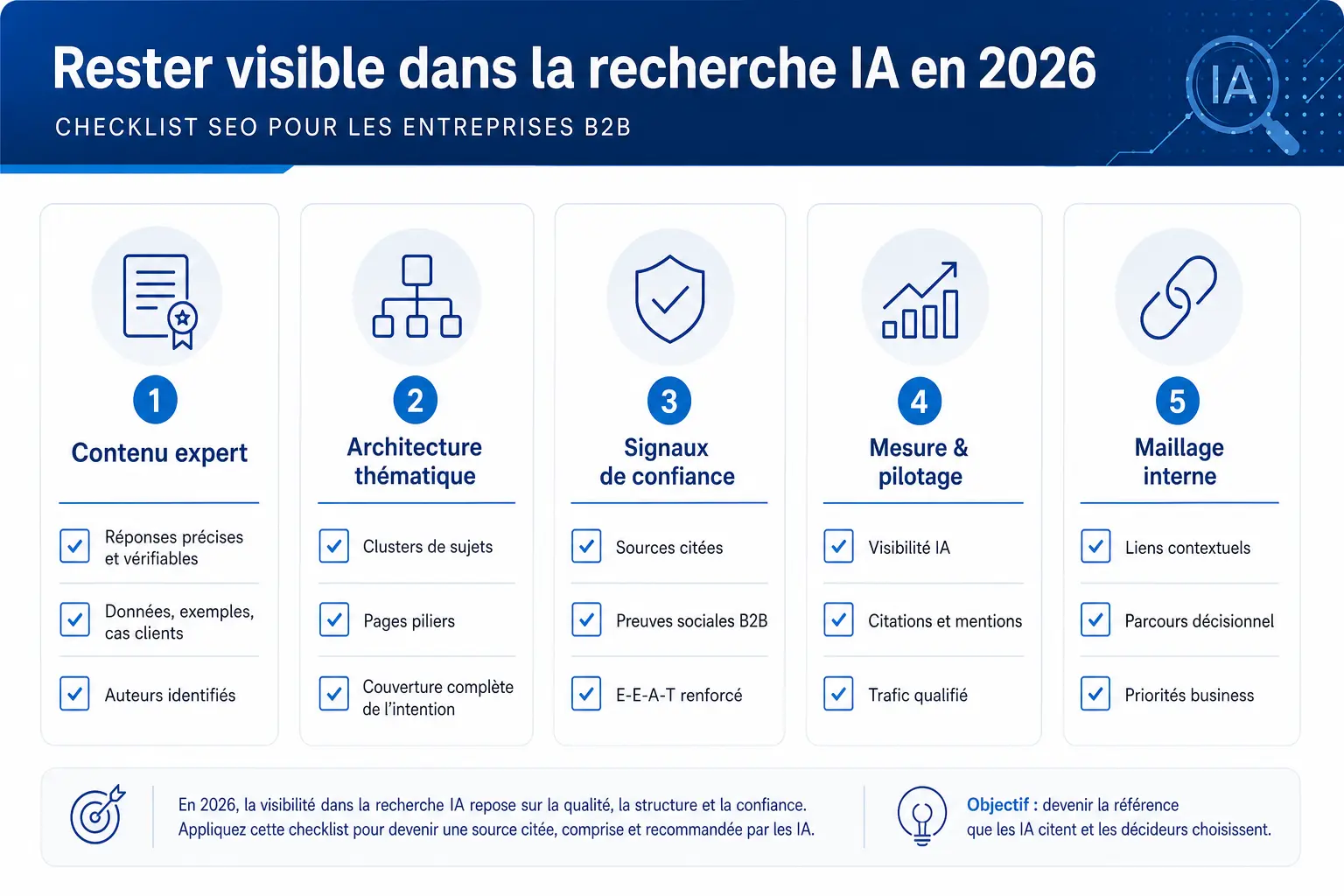
The right question is not ‘how many articles to publish?’ but ‘which content genuinely deserves to exist?’ The most useful formats today: pillar pages, practical guides, comparisons, business FAQs, case studies, decision-support content, service pages enriched by real proof. Every piece of content should be able to answer this question: how does it help the user better than the pages already visible?
Build a strong thematic architecture
The site should be conceived as an editorial system, not as a collection of isolated pages. A strong architecture connects service pages, pillar pages, informational content, proof pages, FAQs, case studies and brand content. This logic benefits the user, the search engine and the brand simultaneously.
Strengthen trust signals
Identified author, expert bio, publication and update dates, properly cited sources, robust ‘about’ page, proof of experience, client references or methodology where relevant, consistency between commercial promise and editorial content.
Structure content to be readable, citable and summarisable
The most useful content in the AI era knows how to alternate depth, clarity and synthesis: well-named sections, direct answers, synthesis blocks, simple formulations, examples, comparisons, real FAQs and easily reusable elements.
Measure beyond rankings
Rankings remain useful, but they are no longer enough. You also need to observe: actual intent coveragens, les impressions sur les requêtes stratégiques, la qualité du trafic, la contribution business, la performance des pages par étape de parcours et la place des contenus de preuve dans la conversion.
What Google actually says about AI and visibility
It is useful to return to a simple point: Google does not require ‘special AI optimisation’ in the sense of a new magic recipe. Its official documentation primarily emphasises three things:
SEO fundamentals remain valid. Content must be indexable, accessible, clear and useful.
AI-generated content is not prohibited. What matters is quality, relevance, accuracy and added value.
Content designed to manipulate visibility or published at scale without genuine contribution remain problematic.
This is good news for serious brands. It means the answer is not to look for a ‘magic GEO trick’, but to produce smarter, better-structured and more credible content.
Why this topic directly concerns B2B companies et de services
In B2B and services, journeys are rarely linear. Decision-makers compare, verify, return, read, cross-reference sources, consult expert content and form an opinion before converting. In this context, visibility doesn’t only depend on a well-ranked page. It depends on a brand’s ability to appear as competent, consistent, reassuring, useful and credible at multiple stages of the journey.
The winning brand is therefore not simply the one that takes a position in Google. It is the one that appears most credible at the moment when the decision is being formed.
The right approach in 2026 : SEO, contenu, crédibilité, marque
SEO in the age of AI is not the end of organic search. It is the end of simplistic SEO. It is no longer just about positioning a page, inserting a keyword or publishing faster than others.
The subject becomes: creating genuinely useful content, building credible authority, clarifying brand expertise, structuring information for both humans and search engines, and connecting SEO to editorial strategy and business strategy.
The companies that will progress in this new landscape are those that treat SEO as a global discipline: content, technical, UX, linking, proof, trust and editorial intelligence.
Is your SEO visibility ready for generative environments?
If your site publishes a lot but converts little, if your content lacks depth or if your editorial architecture doesn’t help your pages reinforce each other enough, it’s time to rethink the strategy from the ground up.
FAQ: SEO and AI
References
- Google Search Central — Google Search’s guidance on using generative AI content
- Google Search Central — AI Features and Your Website
- Google Search Central — Creating Helpful, Reliable, People-First Content
- Google Search Central — Mark up FAQs with structured data
- Google — Search Quality Evaluator Guidelines