
Advertising Trends 2026: How to Stay on Track as AI, GEA and Social Search Redefine the Landscape

cover-ads-trends-2026

Advertising in 2026: Staying on Track in the Age of Artificial Intelligence

When historical benchmarks are no longer enough


“The digital advertising landscape is no longer just evolving, it is changing its logic.”


The models that shaped performance over the past twenty years are not disappearing, but they are no longer sufficient to explain how a brand becomes visible, credible and chosen in 2026.


Traditional SEA link lists are gradually giving way to AI-generated answers. Social platforms are becoming search engines in their own right. Targeting is narrowing while automation continues to accelerate.


If you feel like you are navigating a less readable environment, that is normal. The reference points have shifted.


“In 2026, the challenge is no longer just about being visible, but about being integrated into the answers produced by artificial intelligence.”


In short, be present where your customers are searching.
1. From SEA to GEA

From SEA to GEA, generative advertising and AI

Advertising becomes generative and conversational

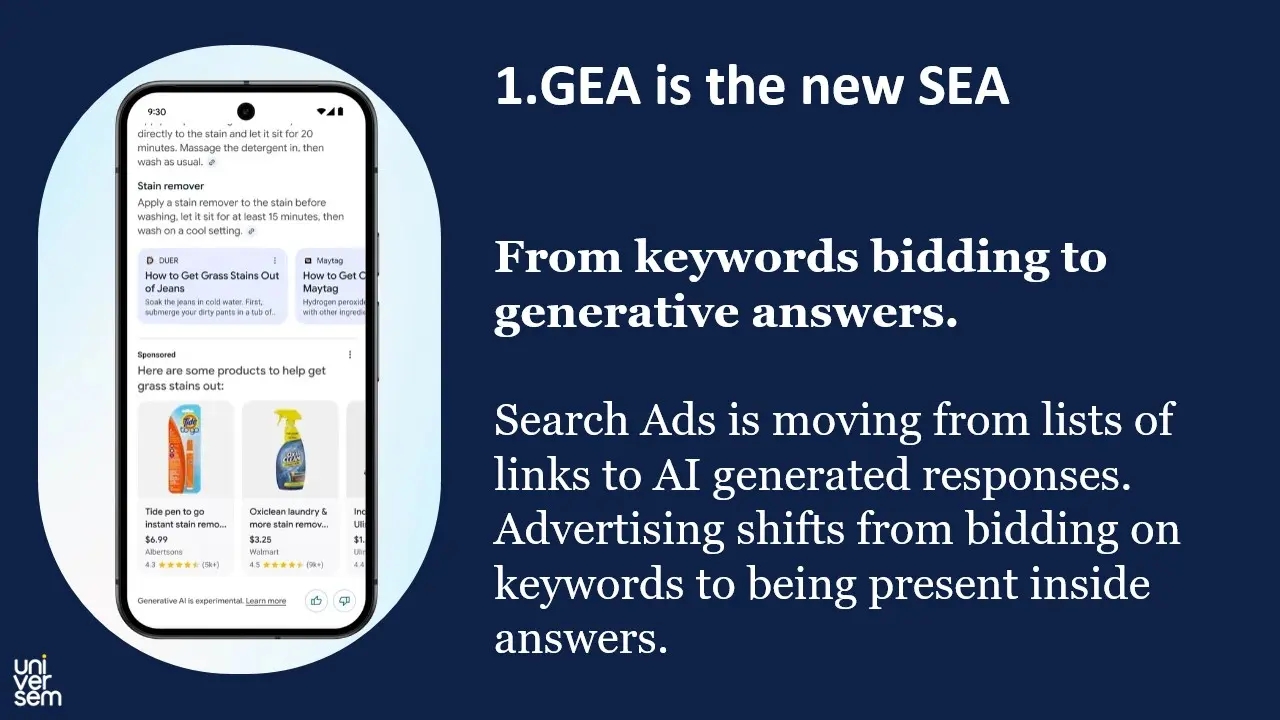
The shift is first and foremost structural. Traditional SEA, built around keyword bidding and click optimization, is evolving into GEA, Generative Engine Advertising. AI-powered engines and interfaces no longer simply display links, they generate complete answers.

Users are no longer just looking for a provider. They ask complex questions, compare options and seek contextualized recommendations. With AI Mode and Gemini, Google generates answers in which advertising formats from Search, Shopping or Performance Max are directly embedded. Advertising no longer appears alongside the answer, it becomes part of it. We have also published an article on the strategies to adopt for your advertising campaigns with the arrival of Google’s AI Mode, link.

This logic now goes beyond Google. In early February 2026, OpenAI launched a beta phase for advertising in ChatGPT in the United States, confirming that conversational interfaces are becoming new advertising spaces. Access is deliberately limited, with high entry budgets of $200k and inventory treated as premium, in order to test which formats truly deliver value to users before a broader rollout. Reported CPMs are around $60, which is very high compared to Display or Social, but consistent with CPMs on high-intent SEA queries.

In these environments, one rule applies: advertising is only acceptable if it integrates naturally into the AI’s reasoning, without breaking the relationship of trust with the user.

Key takeaway

Search is becoming a space for dialogue. Visibility is no longer bought solely through bidding, it is built through the quality and consistency of the signals sent to AI systems.

2. Social Search

Social Search, search on social platforms

Your customers are searching elsewhere

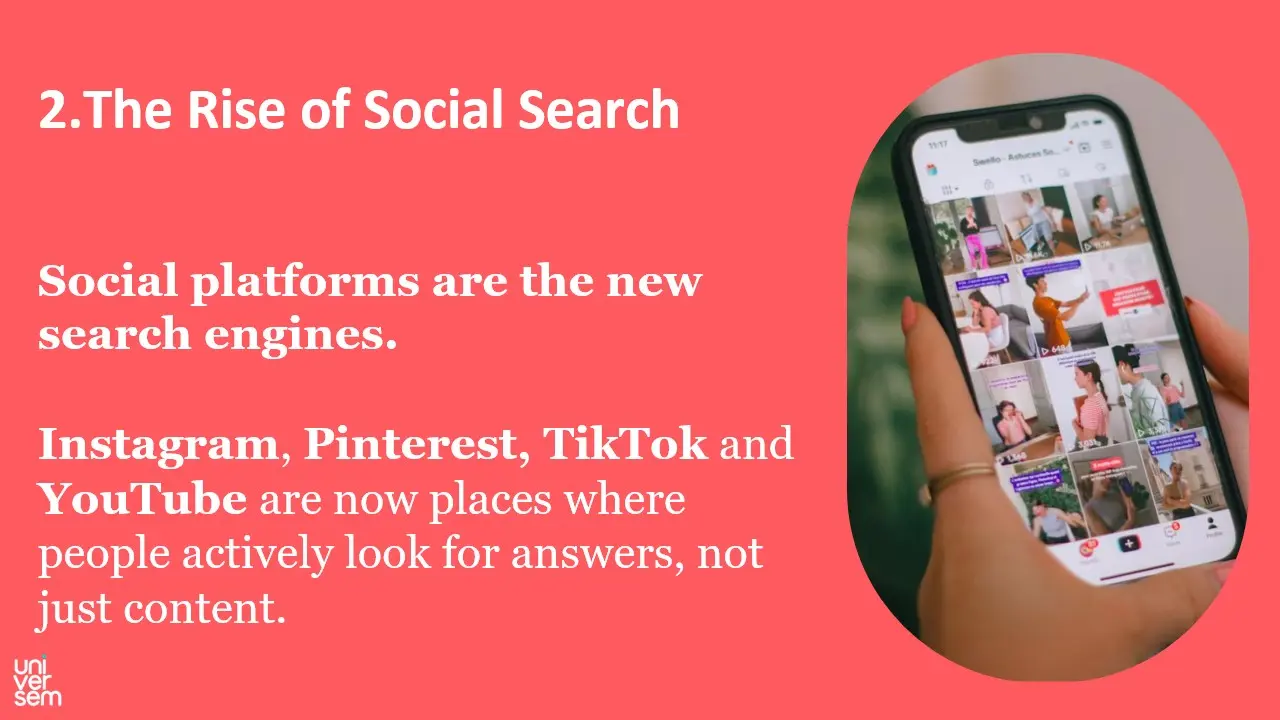
Traditional search engines are no longer the only entry point. TikTok, Instagram, YouTube or Pinterest have become full-fledged search engines, especially for younger generations. According to an eMarketer study, nearly one in two users now start their journey on a social platform rather than on Google.

Scrolling is no longer just about entertainment. People search, compare and decide. For brands, this means building a consistent presence across multiple platforms, with content that addresses real intent, not just visibility.

3. Multi-platforms

Multi-platform strategy and fragmented customer journeys

Being present without spreading yourself too thin

User journeys are no longer linear. A prospect discovers a brand on a social platform, searches for it on Google, checks reviews elsewhere, and eventually converts later through another channel.

Performance is no longer driven by a single platform, but by message consistency throughout the entire journey. The challenge is not to be everywhere, but to remain clear, recognizable and relevant at every touchpoint, depending on the audiences and personas targeted.

4. Local media

Local media, context and proximity in the age of AI

The return of context and proximity

In the age of generative AI, context is regaining its value. Local media, premium environments and contextual inventory allow brands to anchor themselves in credible, useful and consumer-relevant ecosystems.

Local is no longer a secondary option. It is becoming a strategic lever to stand out in a world saturated with automated messages.

5. Less targeting, more creativity

Less targeting, more creativity, the key role of creative assets

Creative assets become the primary signal

Targeting options are gradually shrinking across platforms, whether on Google with Performance Max or on Meta with Advantage+. At the same time, algorithms are maturing and taking on a growing share of delivery.

As a direct result, platforms increasingly rely on creative assets to understand context, intent and message relevance. Images, videos, formats and copy are becoming the main performance signals. Creativity is no longer just a visual layer, it now sits at the core of the advertising system, capable of making the difference depending on platforms, use cases and target audiences.

In this more restrictive targeting environment, first-party audiences remain a key lever. CRM data, customer audiences or qualified visitors make it possible to activate effective remarketing, fuel relevant lookalike audiences and restore precision to algorithms.

Key takeaway

As targeting becomes more limited, creativity turns strategic and fully unlocks its potential when built on strong custom audiences.

6. Video and UGC

Video and UGC, dominant formats across platforms

The dominant formats

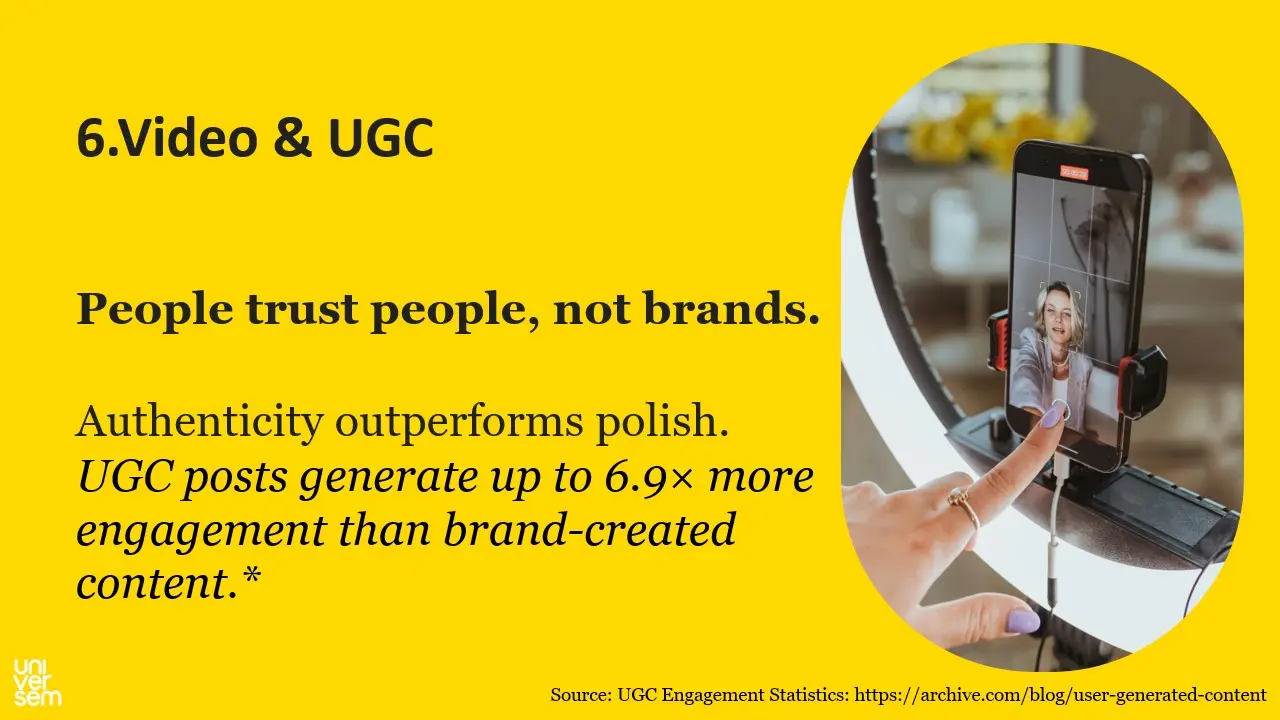
Short-form video and UGC content are becoming dominant across all platforms. They perform well because they mirror real user behaviors, build trust and integrate naturally into feeds.

Overly institutional content tends to fall flat. Human, authentic and contextualized formats clearly take the lead.

7. AI at Universem

AI at Universem, creative acceleration and performance

Accelerating without losing direction

At Universem, AI is used as a co-pilot to do more while maintaining the same level of quality. The Advertising team relies on various AI models to diversify campaign creatives in close alignment with clients, adapt formats and messages across platforms, turn images into videos and test faster in order to learn more quickly and drive conversions.

Strategy, positioning and coherence remain human. AI accelerates execution, it does not replace vision.

Conclusion

Strategy as a compass

Advertising in 2026 leaves no room for improvisation. The shift toward generative, conversational advertising driven by GEA is now firmly established. Visibility is no longer determined solely by bidding, but by brands’ ability to integrate meaningfully into the answers produced by artificial intelligence.

Customer journeys are becoming fragmented, touchpoints are multiplying, and creativity is emerging as a central signal. Social Search, video, UGC and first-party audiences are redefining performance in increasingly automated environments.

At Universem, performance is built on the alignment of all these pillars:


  • advertising to activate demand,

  • SEO and GEO to secure long-term visibility within AI-generated answers,

  • data and analytics to precisely manage complex customer journeys.

Brands capable of orchestrating these levers will turn complexity into a competitive advantage. The others risk becoming invisible, not because of a lack of budget, but because of a lack of direction.

Take action with Universem

GEA, AI Mode, Social Search, advertising in ChatGPT, the advertising landscape is evolving at an unprecedented pace. In AI-driven environments, improvisation is no longer an option.

At Universem, we support companies in Belgium and internationally to build high-performing advertising strategies, aligned with SEO and GEO, and driven by data.

The goal is to maintain a clear direction, even as the rules keep changing.

Looking to audit your current strategy, challenge your campaigns or structure a tailored approach to your business challenges?