
ChatGPT Ads is coming to Belgium: new gold rush or just a copy of Google?
 Hubert de Cartier·AUGUST 20, 2026·8 MIN
Starting the week of August 24, 2026, advertising will appear in ChatGPT in Belgium. Belgian consumers will start seeing ads tied to the context of their conversation when they look for holiday ideas, compare software for their business, or search for a gift idea.
An advertising platform with a different intent context
In short
On Google, intent is inferred from a query. In ChatGPT, the user spells out their budget, constraints and the options they’ve already considered, a context that’s especially useful during discovery and consideration.
After several months of testing in the United States and a gradual rollout to other markets, OpenAI confirms the arrival of ChatGPT Ads in 31 European markets. The ads will target users on the Free and Go plans, while Plus, Pro, Business, Enterprise and Education stay ad-free.
ChatGPT is becoming a new platform through which advertisers can buy attention right as an intent takes shape. Does that mean shifting Google Ads budgets over to ChatGPT? The comparison is worth making, but today the two environments play different, complementary roles.
More broadly, search no longer happens in one place. Google remains essential, but consumers also search on YouTube, TikTok, Amazon, marketplaces, Google Maps, and now AI assistants. Advertising is already following this fragmentation, something we call “Global Search.” ChatGPT Ads adds a new touchpoint, still young, but different enough to deserve marketers’ attention.
The main appeal of ChatGPT Ads isn’t reproducing a search results page. On Google, intent is broad, a short query, a brand name, an informational search, with more and more AI layered in through AI Overviews and AI Mode. In ChatGPT, the user can spell out their budget, constraints, preferences, and the options they’ve already considered.
The potential audience is far from marginal. OpenAI states that over a billion people now use ChatGPT, but that figure shouldn’t be confused with advertising reach: only the Free and Go plans are exposed to ads, though that still represents over 90% of ChatGPT’s users. In February 2026, OpenAI reported 50 million paying users, plus another 9 million business users.
20%
Queries with commercial intent (source: OpenAI)
90%+
Share of ChatGPT users exposed to ads
1/4
Belgians who say they use ChatGPT (Space study, mid-2025)
At Cannes Lions, Dave Dugan, OpenAI’s global head of advertising solutions, estimated that around 20% of queries carried direct commercial intent. That figure remains a number reported by OpenAI, without a published methodology, but it illustrates the appeal of the format for moments when a user is already comparing products or services. Every week, millions of consumers make purchase decisions inside LLMs. As a brand, you can influence those buying journeys with GEO and now with advertising too (Generative Engine Advertising, or GEA).
Definition
- Generative Engine Advertising (GEA)
- Buying ad space inside generative AI assistants. Distinct from GEO (Generative Engine Optimisation), which targets a brand’s organic visibility in generated answers. The parallel with SEA and SEO is useful, even if the mechanics differ.
For Belgium, one limitation remains: OpenAI now publishes usage data by country through Signals, but not an official figure for active Belgian users that would let anyone size the reach available for a campaign. Signals data also covers individual Free, Go, Plus and Pro accounts, and shows that professional usage exists on these personal accounts too. Free and Go advertising audiences shouldn’t be reduced to purely private use, especially given the Shadow IT at large companies that don’t hold paid ChatGPT licences. A Space study from mid-2025 found that one in four Belgians says they use ChatGPT.
Lastly, the arrival of advertising also answers an economic need for OpenAI. The company explicitly presents ads as a way to support free or low-cost access to ChatGPT and to fund continued investment in the product. That reinforces the idea that advertising is set to become a lasting part of the ecosystem, even if its format and weight can still shift significantly.
What an advertiser can actually do today with ChatGPT Ads
In short
Three levels (campaign, ad group, ad), three bidding strategies (CPM, CPC, oCPC), and targeting built on “context hints” rather than purchased keywords.
The overall setup will feel familiar to a team used to Google Ads or Meta Ads. OpenAI Ads Manager Beta is built on three levels: a campaign to define the objective, budget, dates and targeting; an ad group to organize themes and context hints; then the ad itself, with its headline, description, image and landing page. In Belgium, as in 30 other European markets, the launch will first run through OpenAI’s Ads Solutions teams, agencies and technology partners, ahead of a self-service rollout announced for later in the summer. This point could evolve quickly.
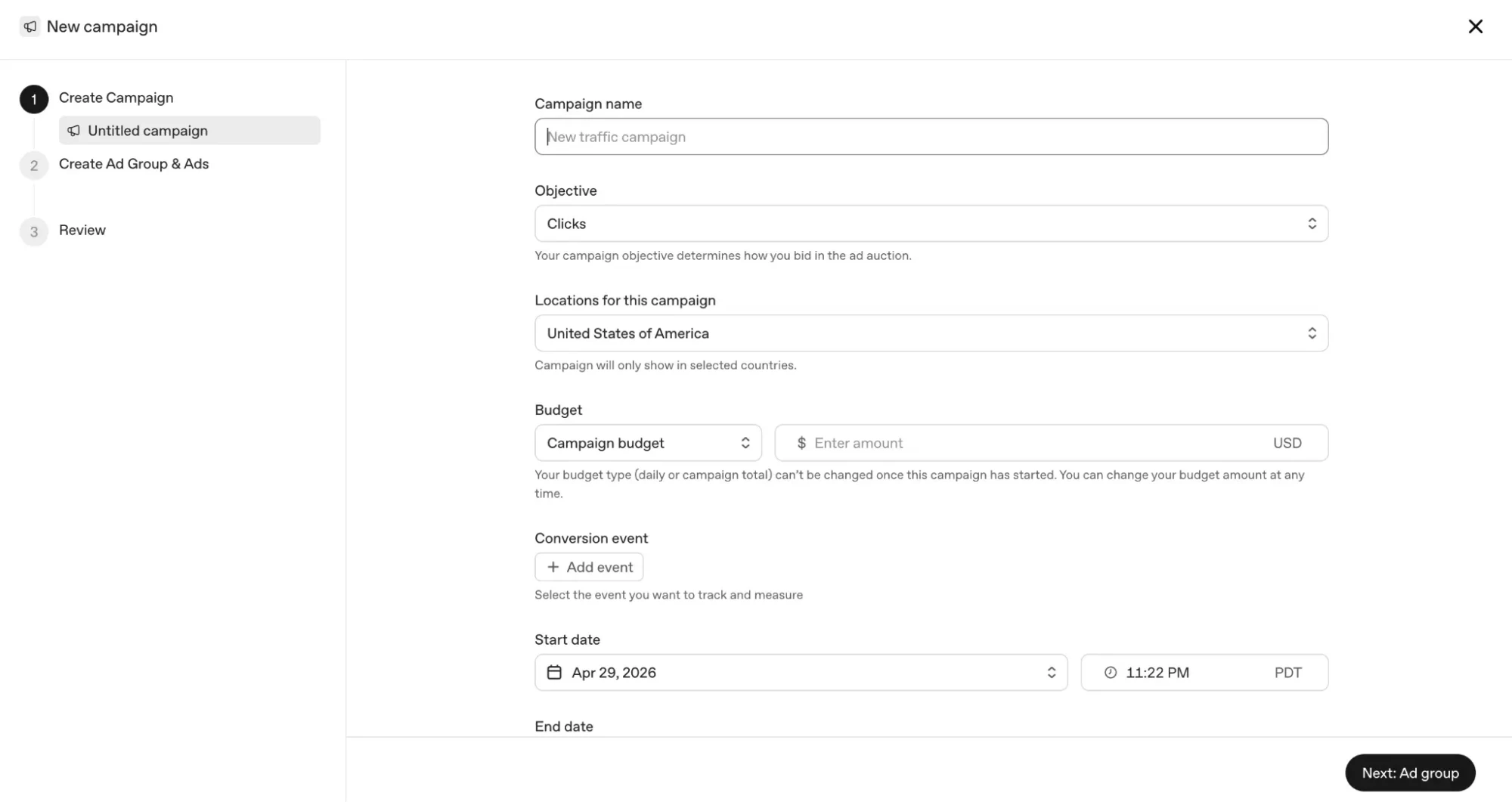
Three bidding strategies are documented so far. CPM targets reach and charges per thousand impressions. CPC targets clicks and charges per valid click. oCPC optimizes delivery toward a chosen conversion, a purchase, a signup, or a lead, but billing still runs on clicks. Optimizing for conversion requires tracking through the OpenAI Pixel or the Conversions API (server-side).
Targeting, on the other hand, differs from Google Search. There’s no exact keyword purchased by the advertiser. Ad groups can be given “context hints” describing conversations, topics or words likely to be relevant. OpenAI notes that these hints guide the matching but don’t guarantee delivery within a specific conversation. The system is therefore more algorithmic, and less directly controllable, than buying by keyword.
Campaigns can also target countries, platforms (Web, iOS or Android) and custom audiences. For custom audiences, OpenAI requires at least 25,000 matched users and recommends audiences of 100,000 or more, a threshold that may limit the appeal of the tool for some Belgian SMEs. An important point for a multilingual country: current campaign-creation documentation covers country, platform and custom audiences, but no separate language-targeting parameter comparable to Google Ads.
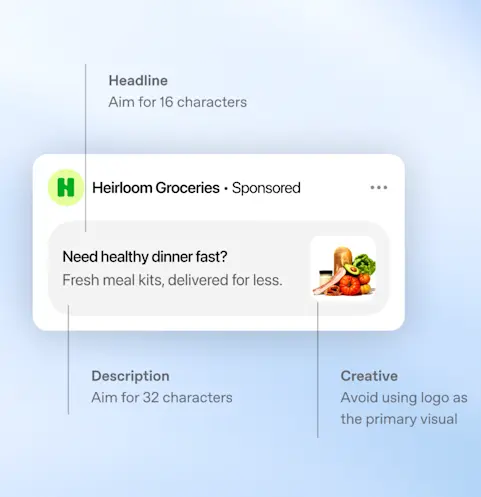
On the creative side, the format stays deliberately simple: advertiser name, logo, headline, description, landing page and image. For e-commerce, OpenAI also lets advertisers build campaigns from a product feed, with details like the image, title, price and availability. A partnership with Shopify makes this possible.
Finally, for CPC campaigns OpenAI recommends starting with a maximum bid of $3 to $5 per click (the platform can also be used in €). This isn’t an average observed CPC, but a recommended starting cap. It could rule out plenty of sectors where margins are too thin to justify a click that expensive. CPM buying can also be a good fit in certain cases.
ChatGPT Ads and Google Ads: complementary logics
In short
Google offers depth of inventory, data and measurement. ChatGPT brings a different signal: the context of a conversation where the user spells out their need. Not the same scale, not the same maturity, not the same role.
Comparing with Google Ads is useful as long as you’re not looking for a winner. Google has a depth of inventory, data and measurement tools built up over more than twenty years. ChatGPT brings a different signal: the context of a conversation where the user can spell out their need. As of August 2026, the two platforms match neither in scale, nor maturity, nor exact role in the customer journey.
| Criteria | ChatGPT Ads (August 2026) | Google Ads |
|---|---|---|
| Audience exposed | ChatGPT Free and Go users | Users of Google’s advertising surfaces: Search, Maps, YouTube, Discover, Gmail and the Display Network |
| Targeting logic | Conversation context and intent, context hints supplied by the advertiser, country, platform and custom audiences | Queries, keywords, location, languages, audiences and proprietary signals depending on campaign type |
| Language targeting | No separate language parameter documented at this stage in campaign creation | Documented language targeting, with a change announced from September 2026 for Search that will restrict targeting |
| Formats | Sponsored ad shown separately from the answer (text, image, landing page), plus product-feed-based campaigns | Search, Shopping, image, video and automated formats depending on campaigns and platforms |
| Optimization and bidding | CPM for reach, CPC for clicks, oCPC to optimize toward a conversion, billed on clicks | CPM and CPC depending on campaigns, then conversion-oriented strategies: target CPA, target ROAS, maximize conversions or conversion value |
| Measurement | Impressions, clicks, spend, CTR, average CPC, average CPM, conversions, OpenAI Pixel and Conversions API | Very mature measurement: impressions, clicks, conversions, attribution, online and offline conversions, Analytics integrations and automated strategies |
| Transparency on demand | No public equivalent documented to the search terms report; matching is largely algorithmic | Search terms report for Search, complemented by thematic analysis and automated signals |
| Maturity | Still in beta, features and availability evolving fast | Mature ecosystem, broad reach and years of data and optimization |
This comparison mostly highlights a difference in maturity. Google remains far more complete today at capturing demand at scale and driving performance with a wide range of signals. ChatGPT Ads adds a different touchpoint, potentially interesting when a user is still shaping their decision. That complementarity is what’s worth testing before considering replacing one with the other.
Shape your paid acquisition mix with our SEA experts→
An opportunity to test, not a revolution to declare
In short
Test where the economics and the intent justify it, measure separately, compare against existing channels, and learn fast: results will vary from one advertiser to the next.
ChatGPT Ads is a new way to reach consumers right as they explore, compare or refine a need. The appeal is real, especially for brands whose purchase decisions need context, advice or comparison. But the platform still carries real limitations today: advertising reach below ChatGPT’s total user base, self-service access still partial in Europe, little transparency into which conversations trigger an ad, and targeting granularity still below Google Ads.
It’s also worth clearly distinguishing advertising (GEA) from GEO. Ads are separate from answers and don’t influence ChatGPT’s organic recommendations. A brand can work on its organic visibility in AI answers and, separately, test advertising as a paid lever. The parallel with SEO and SEA is useful to understand the complementarity, even though the mechanics differ.
What’s really worth watching is how fast the platform is evolving. In just a few months, OpenAI has added CPC on top of CPM, then conversion optimization, geographic targeting, custom audiences, the Pixel, the Conversions API and product-feed campaigns. It would be premature to judge ChatGPT Ads solely on what it can do today, and just as premature to already treat it as a new universal pillar of the media mix.
Our read is simple: test where the economics and the intent justify it, measure separately, compare against existing channels, and learn fast, because results will vary from one advertiser to the next. All while also tracking your brand’s presence in LLMs, to understand how this new paid channel connects with organic results (GEO) and your share of voice in the answers given.
ChatGPT Ads adds a new way to reach the right audience at the right moment, provided you approach it with curiosity, measurement and a critical eye.
This is also what makes digital marketing so interesting right now. The real question is where an intent is born, where a brand gets discovered, where it gets compared, and where the decision gets made, with or without ChatGPT. Google, social networks, marketplaces, YouTube, Maps and AI assistants now all play a part in a more fragmented journey. That’s the whole point of a digital strategy built around journeys rather than isolated channels.
Frequently asked questions
When is ChatGPT Ads coming to Belgium?+
Starting the week of August 24, 2026. OpenAI is rolling out ChatGPT Ads across 31 European markets, including Belgium.
Who sees ads in ChatGPT?+
Only users on the Free and Go plans, over 90% of ChatGPT’s user base. Plus, Pro, Business, Enterprise and Education stay ad-free.
How does ChatGPT Ads targeting work?+
There’s no exact keyword purchased by the advertiser. Ad groups receive “context hints” describing relevant conversations, topics or words. Targeting relies on the topic of the current conversation and a few contextual signals, with no access to history or the user’s account. Campaigns can also target countries, platforms (Web, iOS, Android) and custom audiences.
What bidding strategies are available?+
Three strategies are documented: CPM (billed per thousand impressions, geared toward reach), CPC (billed per valid click) and oCPC (optimizes toward a conversion, billed on clicks). oCPC requires tracking through the OpenAI Pixel or the Conversions API.
How much does a ChatGPT Ads campaign cost?+
OpenAI recommends starting CPC campaigns with a maximum bid of $3 to $5 per click. It’s a recommended starting cap, not an average observed CPC. This level can rule out sectors whose margins don’t justify a click that expensive.
Should you shift Google Ads budget to ChatGPT Ads?+
Not at this stage. As of August 2026, the two platforms don’t match in scale, maturity, or role in the customer journey. Google remains far more complete at capturing demand at scale. ChatGPT Ads is best approached as a complementary touchpoint worth testing, with separate measurement.
What’s the difference between GEO and GEA?+
GEO (Generative Engine Optimisation) builds a brand’s organic visibility in generative AI answers. GEA (Generative Engine Advertising) refers to buying ad space within those same environments. Ads sit separately from answers and don’t influence ChatGPT’s organic recommendations: the two levers are worked separately, much like SEO and SEA.
How can a Belgian advertiser access ChatGPT Ads?+
At launch, access runs through OpenAI’s Ads Solutions teams, agencies and technology partners. A self-service rollout has been announced for later in the summer.