
Global Search, a complete approach to positioning your brand in the age of AI
Customer journeys are rapidly evolving
Today, users seamlessly move between Google, ChatGPT, Perplexity, YouTube, TikTok, Pinterest… They no longer search on a single engine. They search everywhere, depending on their needs in the moment. Search is now fragmented, multi-platform, and deeply shaped by AI.
Two key forces are driving this shift:
- The buying journey is no longer linear. We’re now in the “messy middle”, where users continuously switch between exploration and comparison across multiple sources, increasing audience fragmentation across platforms.
- AI is reshaping expectations. Users don’t want links anymore. They want answers, summaries, and recommendations. This simplicity is appealing, even if it comes with risks such as limited critical thinking or potential AI hallucinations.
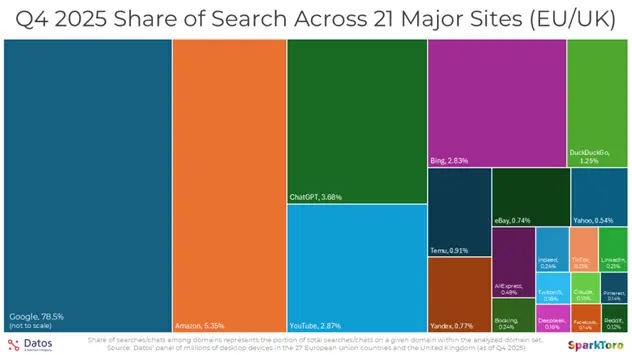
The battle is no longer just happening on Google. It’s happening across every surface where intent exists. This is confirmed by the latest study from Datos/Semrush, showing that while Google remains dominant, a significant share of searches now happens on platforms like Amazon, ChatGPT, or YouTube.
Customer journeys are evolving fast, in parallel with rapid advancements in AI and LLMs. The question is no longer whether things will change, but how fast brands can adapt, today, tomorrow, and beyond.
Global Search, combining organic strength with paid precision
For years, digital strategies were built in silos. SEO focused on long-term visibility, SEA on immediate performance, and social on engagement. But this no longer reflects how users behave.
Users don’t think in channels. They browse, discover, compare, explore, and decide, often without even realizing it. Intent is the key signal that should guide your strategy.
And intent itself varies. Users might get inspired and discover through video content on TikTok, Instagram, or YouTube. They might also compare prices, restaurants, or hotels on Booking or Google Maps. And of course, they can search on Google, ChatGPT, Claude, or Bing.
Each platform has its own logic, its own codes, and requires a different message.
A single journey can start on TikTok, continue on Google, be validated through ChatGPT, and end on a marketplace. In this context, separating organic and paid strategies no longer makes sense. These channels must work together to capture and support intent at every stage.
Organic plays a key role in building long-term presence. It helps brands exist over time, build trust, and feed search engines and AI with reliable content, especially through GEO (Generative Engine Optimization).
Paid media brings precision and speed. It allows brands to capture short-term opportunities, test strategies, and secure key moments in the journey.
Advertising within LLMs is expected to launch in Belgium soon, through ChatGPT, Google AI Mode, or Gemini. This will introduce GEA (Generative Engine Advertising), opening new ways to optimize investments.
It’s their combination that truly creates value.
In a fragmented environment, each channel contributes to a different stage of the journey. The challenge is no longer to optimize each one separately, but to understand how they interact. This calls for a more holistic and strategic view of search.
Google remains a key player, with a dominant market share. But it is no longer the only one. Conversational engines like ChatGPT or Perplexity, platforms like Amazon or TikTok, and visual environments like Pinterest have become major entry points.
Each captures a share of intent, with its own formats, rules, and audiences.
In this context, the rise of zero-click adds another layer of complexity. Users increasingly get answers without clicking. Information is delivered directly within platforms, through AI Overviews or conversational interfaces.
Visibility is still there, but it’s less tangible. It influences decisions more than it drives traffic.
And this is just the beginning. The rise of AI agents will further transform how users search, discover, and interact with brands.
One thing is certain: search will keep evolving, fast. And agility will be key.
This forces brands to rethink how they measure performance, and how they combine organic and paid efforts.
How to succeed in the era of Global Search?
In such a fast-moving environment, one question keeps coming up: how do you stay in control?
The first shift is measurement. Traditional KPIs still matter, but they no longer reflect the full picture. A growing share of value now happens before the click, in interactions that are harder to track.
New indicators are emerging, such as brand visibility (mentions, citations) or brand perception within LLMs.
A user might discover a brand through a video, explore it via AI, and convert days later through another channel. In this context, attribution becomes complex, and sometimes misleading.
New approaches are needed. Not to reach perfect accuracy, but to rebuild a global view. Measuring visibility in AI environments, analyzing third-party content, or using incrementality models can provide valuable insights.
Ultimately, value doesn’t come from tools. It comes from how they work together.
Yet despite all this change, the fundamentals remain surprisingly stable.
You can’t compensate for a weak product or experience with marketing alone. Search engines, AI, and users all converge toward the same signals: relevance, satisfaction, and consistency.
In this environment, the brand plays a critical role. It becomes a reference point, a source of trust, in increasingly complex journeys.
And this trust is no longer built only through brand messaging. It comes from an entire ecosystem: reviews, comparisons, user-generated content, media mentions.
These signals feed both search engines and AI systems.
This goes beyond marketing. Customer experience, service quality, and overall consistency now directly impact visibility.
Succeeding in Global Search is not about mastering each channel individually. It’s about understanding intent, showing up at the right moments, and building a strong brand that can stand out in an ever-changing environment.
Our approach to Global Search at Universem
Since 2007, we’ve been evolving alongside Search. First with our own e-commerce business, where we ranked #1 on highly competitive keywords, then with the creation of Universem in 2010. “Search” is part of our DNA.
The landscape has evolved dramatically. Google keeps improving access to quality information, while users adopt new behaviors driven by AI and LLMs.
With R&D at the core of our approach, we’ve been working for years on:
- Automating analysis to better understand user behavior and intent
- Developing new frameworks to integrate AI and LLMs into measurement (GEO, GEA)
- Building systems to track trends and optimize budget allocation
- Strengthening the role of data across all strategies
- Structuring senior teams to manage complex, integrated strategies
- Sharing insights, weak signals, and best practices with our clients
For nearly 20 years, we have been living and breathing Search, and it’s not about to stop, with ongoing weekly evolutions bringing challenges, but above all opportunities for ambitious and agile brands ready to seize them!
Want to learn more? Join us for the “Global Search” webinar this Thursday, April 9 at 11am for a complete overview, concrete examples applied to customer journeys, and much more.
Want to go further?
Get practical insights to adapt your Search strategy in the age of AI.